

$1.1 Million Irrevocable Trust Preserved as Abrams Fensterman Overturns Medicaid Denial
Moriah Adamo and Julia L. Santo Prevail at Fair Hearing After Prior Counsel Viewed Matter as Unsalvageable
Abrams Fensterman, LLP Partner & Manager of the Elder Law and Estate Planning & Administration
Department, Moriah Adamo, and Associate, Julia L. Santo, secured a significant victory for a client whose Medicaid application had been denied after a New York City agency treated irrevocable trust property as available resources.
In a decision dated August 11, 2026, the New York State Department of Health reversed the agency’s determination that the client had excess resources for Medicaid eligibility purposes. The decision concluded that more than $1.1 million in trust principal was not available to the client under the governing trust provisions, and, therefore, the agency will be directed to provide much needed home care services.
Challenging the Treatment of Irrevocable Trust Assets
The client applied for Medicaid coverage, including community based long term care services. The agency denied the application after counting the principal of irrevocable trusts as available resources.
Each trust expressly stated that it was irrevocable and prohibited the trustees from invading the principal for the client’s benefit. The agency nevertheless argued that two provisions made the trust assets available: one addressing the sale and replacement of trust owned real property, and another authorizing the trustee to retain and compensate geriatric care managers and other professionals.
Our team challenged that interpretation through the Medicaid fair hearing process. They argued that the trusts had to be interpreted as complete documents and that neither provision permitted the client to receive, control or benefit from trust principal.
Department of Health Rejects the Agency’s Interpretation
The fair hearing decision agreed with the arguments advanced by Abrams Fensterman.
Regarding the real property provisions, the decision found that the trustees’ authority to sell trust owned property and acquire a replacement homestead did not give the client access to the proceeds or control over the trust principal. Any unused proceeds remained part of the trusts, and the client had no right to receive them.
The decision also rejected the agency’s interpretation of the provisions authorizing payment to professionals. When read together with the trusts’ express prohibition against using principal for the client’s benefit, those provisions did not permit the trustee to invade principal. Any services benefiting the client could be paid, if at all, from trust income rather than principal.
The Department of Health therefore determined that the agency’s excess resource denial “was not correct” and reversed it.
Why This Medicaid Fair Hearing Decision Matters
This result demonstrates why a Medicaid denial involving a trust should not be accepted without a careful review of the trust language, the agency’s reasoning and the governing law.
The presence of certain powers within an irrevocable trust does not automatically make the trust principal available for Medicaid eligibility purposes. Trust provisions must be interpreted together, and the analysis may depend on whether the applicant can receive, control or benefit from principal under any circumstances.
The decision also highlights the importance of coordinating trust planning with future Medicaid planning and eligibility. Careful drafting can be critical, but effective advocacy is equally important.
Experienced Medicaid Planning and Appeals Counsel
Abrams Fensterman’s Elder Law and Estate Planning & Administration Department
assists individuals and families with Medicaid planning, applications, eligibility disputes, managed care appeals, fair hearings and Article 78 proceedings. The team also advises clients concerning irrevocable trusts, asset protection planning, long term care needs and related estate planning matters.
If Medicaid has denied an application, counted trust assets as available resources or determined that an applicant has excess resources, prompt legal review may preserve important rights and available options.
Related Medicaid Appeals Insight
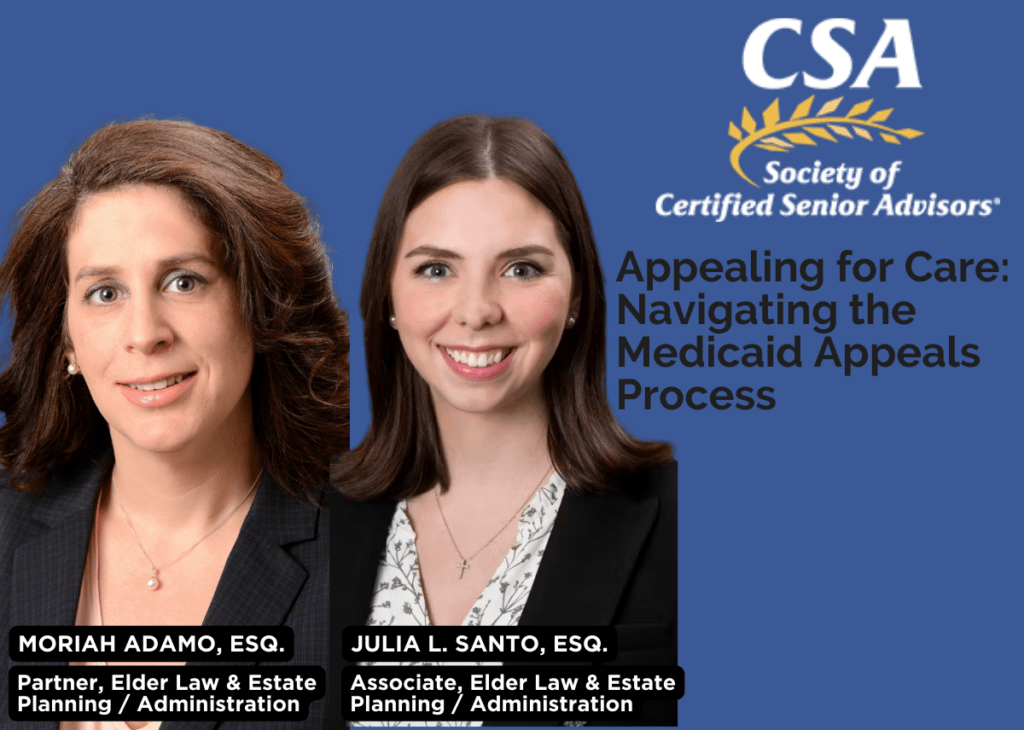
Moriah and Julia also co-authored “Appealing for Care: Navigating the Medicaid Appeals Process,” published in the Society of Certified Senior Advisors Journal. The article explains why Medicaid benefits may be denied or reduced, how financial and service related appeals differ, and what families and professionals should know when challenging an improper determination.
About the Attorneys
Moriah Adamo
Moriah Adamo is a Partner at Abrams Fensterman and leads the firm’s Elder Law and Estate Planning & Administration Department from its Lake Success office. She advises clients concerning estate planning, Medicaid eligibility and appeals, asset protection, guardianships and estate administration. Her experience includes representing clients at Medicaid fair hearings and in Article 78 proceedings, litigating contested estates and developing practical solutions for individuals and families confronting complex long term care needs.
Julia L. Santo
Julia L. Santo is an Associate in Abrams Fensterman’s Elder Law and Estate Planning Group. Her practice focuses on Medicaid planning and appeals, estate planning, estate administration and probate proceedings. Julia is an active member of the New York State Bar Association’s Elder Law & Special Needs and Trusts & Estates Sections and frequently writes and presents on Medicaid, advance directives and long term care planning. She is Co-Vice Chair of the Nassau County Bar Association’s Elder Law, Social Services & Health Advocacy Committee.
CONTACT ABRAMS FENSTERMAN’S ELDER LAW and ESTATE PLANNING & ADMINISTRATION DEPARTMENT