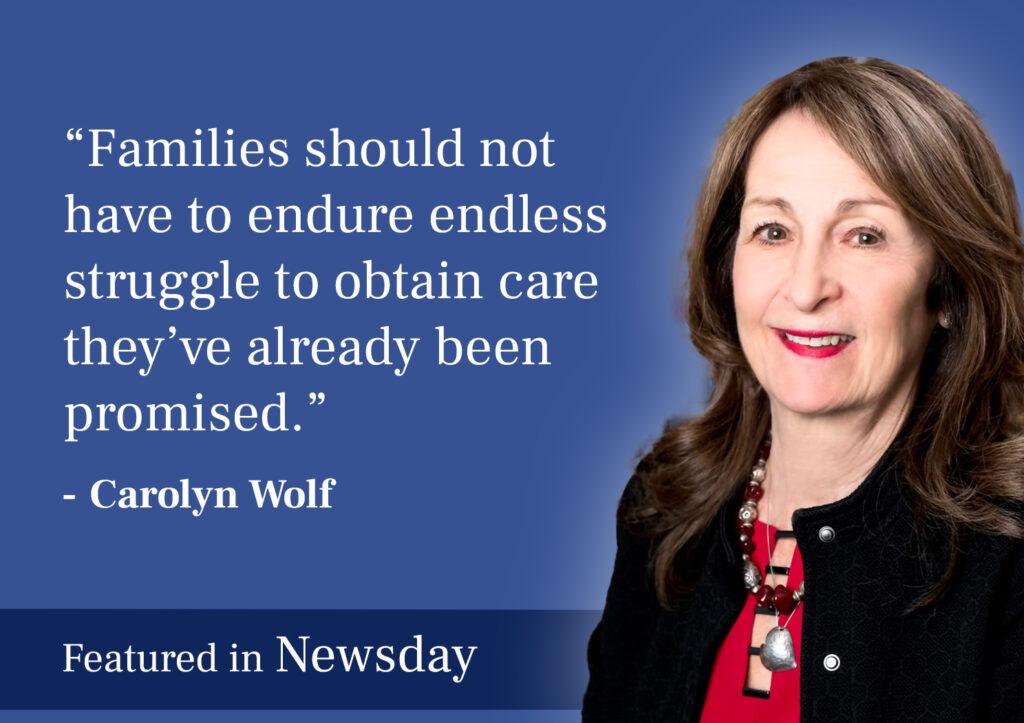


In honor of World Mental Health Day today, Carolyn Reinach Wolf, director of the the mental health law practice at Abrams Fensterman, offers a reminder to attorneys that taking care of themselves is not only a personal obligation but a professional one as well.
By Carolyn Reinach Wolf, Abrams Fensterman, LLP
Today, October 10, is World Mental Health Day which is more than a date on the calendar. It’s a collective reminder that taking care of ourselves is a professional obligation. If we want to preserve the prestige, respect and impact of the legal profession, we have to start with ourselves.
The legal world loves its myths. One common image in the legal world is that of the lawyer as the composed expert—leading the courtroom, dressed sharply, unaffected by stress, always ready and never thrown off course.
This stereotype is so deeply rooted that many begin their careers striving to match it. However, in the quiet hours of a law office at night, the myth fades. You’ll see the partner working through a migraine, the associate quietly breaking down in a glass-walled conference room or the junior lawyer skipping dinner to meet a last-minute deadline.
Despite its prestige and purpose, law often silently wears down many of those practicing it. It’s time the profession stopped treating this as business as usual. The numbers tell a stark story. In 2021, the National Task Force on Lawyer Well-Being reported that 60% of lawyers saw their stress levels rise, while half said their anxiety had worsened. That same year, the New York State Bar Association found that more than a third of attorneys had experienced a mental health concern in the prior three years.
These findings echo a longer-running pattern. A landmark 2016 study by the American Bar Association and the Hazelden Betty Ford Foundation, covering more than 13,000 lawyers, revealed that nearly a third showed symptoms of depression, one in five reported anxiety, one in five qualified as problem drinkers and more than one in ten had seriously contemplated suicide during their careers.
The trend has only intensified. Bloomberg Law’s 2022 survey found that over half of all attorneys felt burned out at least half the time. Among those reporting burnout, 83% struggled with sleep, 81% with anxiety, 43% with depression and 47% with relationship strain. Pandemic-era research added another layer of concern: in New York State, 17% of lawyers admitted to increasing their use of alcohol or drugs to cope.
These are not “tough months.” These are entire careers and lives shaped, sometimes warped, by relentless pressure.
The Structural Roots of Distress & The Hidden Costs of Burnout
Much of this distress is structural. The billable hour reigns supreme, turning every moment of the day into a commodity. Associates quickly internalize that their value is measured in six-minute increments and partners live by the same math, just with bigger targets. Deadlines, quotas and business development push even the most seasoned attorneys to the edge.
Layer onto this the adversarial nature of the job. Law isn’t just intellectually demanding—it’s emotionally bruising. Every negotiation is a contest, every brief a battle, every deal or case has a winner and a loser. It’s a daily fight-or-flight response with no safe harbor. Even on supposed “downtime,” the body and mind rarely switch off.
Client demands only compound the strain. For clients, legal issues are often existential ones, where businesses, family or even freedom itself hang in the balance. The phone rings at midnight; the urgent email arrives during your child’s recital. The message is always the same: deliver perfection and deliver it now.
There are financial pressures, too. Law school debt shadows most associates for years. Firm profitability and business development are constant concerns and in-house counsel face downsizing and “doing more with less.” For many, the stakes never let up.
But perhaps most insidious are the traits that law selects for: high achievers, perfectionists, people who pride themselves on control, independence and endurance. The very qualities that create legal brilliance can, if left unchecked, just as easily breed self-criticism, isolation and a dangerous refusal to ask for help. In a profession that still equates vulnerability with weakness, the stigma around mental health can feel insurmountable.
Ignore the myth and the real costs come into focus. When lawyers are chronically sleep-deprived, their judgment falters. When anxiety runs high, creativity and flexibility suffer. Alcohol and substance abuse, still a taboo topic in many firms, can erode reliability and spark ethical violations.
The Model Rules of Professional Conduct demand competence and diligence. Yet you can’t serve clients, supervise colleagues or fulfill your professional responsibilities if your mind is fogged with exhaustion or your emotional bandwidth is shot.
Why then, despite years of reports and awareness campaigns, does the profession struggle to make progress? In part, it’s culture. Law is deeply hierarchical and rewards stamina. The “iron man” mentality persists: whoever stays latest, whoever never breaks, gets ahead. Admitting struggle—be it to a supervisor, a client or oneself—can feel like professional suicide.
Firms are getting better about providing resources, but too often, employee assistance programs are buried deep in the handbook or accessed only in a crisis. Confidentiality concerns and fear of stigma linger. There’s little incentive to be the first to say, “I need help.”
A Changing Profession in a Changing World
While the pressures of law are longstanding, the context in which today’s lawyers operate has shifted dramatically—and not always in ways that help. Generational expectations are changing. Younger lawyers entering the field are less willing to sacrifice their entire lives for their careers. They have grown up in an era that talks more openly about mental health, work-life balance and the importance of meaning in work. Yet when they step into firms, they encounter a jarring disconnect: a culture that still valorizes 2:00 a.m. emails and weekend work as a badge of honor.
This generational tension has consequences. Associates who feel their values are dismissed often disengage or leave. Firms then find themselves caught in a revolving door of recruitment, training and attrition. Retaining top talent requires more than competitive salaries; it requires cultures that acknowledge humanity. In many cases, younger lawyers aren’t rejecting the practice of law itself, but rejecting a culture that deprioritizes their well-being.
Technology, too, has reshaped the terrain. On one hand, digital tools can reduce drudgery: e- discovery platforms, AI-driven research assistants and project management software can streamline repetitive tasks. On the other hand, the same technology has obliterated natural boundaries. The workday never truly ends when the office is in your pocket, buzzing with client texts, notifications and late-night document reviews. The pandemic accelerated this collapse, blending home and work so thoroughly that many lawyers felt they were living at the office rather than working from home.
Beyond technology, the social context matters too. Lawyers are not insulated from the crises of the wider world, be it economic uncertainty or public health emergencies. Attorneys who represent vulnerable populations, whether in mental health law, family law, criminal defense or immigration, carry a secondary burden in absorbing the trauma of their clients.
The legal profession has always adapted in moments of crisis. The pandemic forced remote hearings and digital filings into the mainstream, changes once deemed unthinkable. The next frontier of adaptation is cultural: redefining strength not as endurance at any cost, but as resilience paired with humanity. If law can meet that challenge, it will not only preserve the health of its practitioners, but also strengthen the trust and integrity of the profession itself.
What Actually Works: Institutional and Individual Solutions
So, what would real change look like?
It starts with leadership. When partners and senior attorneys speak openly about their own stress, burnout or even the fact that they see a therapist, they send a powerful message. That kind of candor gives everyone else permission to seek help without fearing professional consequences.
Change also requires policy and structural shifts. The billable hour may not vanish overnight, but firms can still set realistic workload expectations, build in flexibility and ensure adequate staffing. Rethinking what “productivity” means—by factoring in engagement, retention and well-being alongside profits—signals that success is not just about hours logged, but about sustainable careers.
Access to resources is another crucial step. Mental health programs shouldn’t be hidden away as a last resort; they should be visible, confidential and encouraged. Employee Assistance Programs, counseling, peer support and well-being workshops work best when they’re treated as part of professional development, not emergency exits. That shift helps dismantle stigma and makes seeking support an ordinary part of legal practice.
Managers and partners must also be equipped to spot trouble early. Too often, well-meaning supervisors mishandle signs of distress—brushing them aside or, worse, shaming colleagues. With training, leaders can learn to recognize changes in mood, performance or engagement and respond with constructive support rather than silence.
On the individual side, lawyers need to reclaim their humanity through boundaries, rest and connection. That means a genuine stop time each night, “no email” windows, protected meals and honoring personal commitments. Sleep and exercise aren’t indulgences—they’re professional necessities. Research shows chronic sleep deprivation can impair cognition as severely as alcohol, while even a brisk walk can reduce stress hormones and sharpen focus. And perhaps most importantly, connection—with friends, family or mentors—anchors us in something larger than the next deadline.
Finally, help-seeking must be normalized. Therapy, coaching, support groups—these are tools, not admissions of failure. Early intervention can keep manageable stress from escalating into crisis. The more firm leaders speak openly about using these resources themselves, the safer it becomes for everyone else to follow their lead.
Why This Is a Professional Duty, Not a Luxury
It’s tempting, especially in a competitive profession, to frame well-being as optional. But the truth is the opposite. Lawyer well-being is fundamental to ethical, effective and sustainable legal practice. It’s what allows us to deliver on our professional promises, to serve clients with clarity and judgment and to sustain our careers for the long haul. The National Task Force on Lawyer Well-Being put it plainly in its 2017 report: well-being is not a “nice to have.” It’s a core component of competence and professionalism
My own career has unfolded at the crossroads of law and mental health. I founded the Mental Health Law practice at Abrams Fensterman because I saw, again and again, the cost of ignoring these issues. Through my work as Co-Chair of the New York State Bar Association’s Subcommittee on Mental Health Law, I’ve seen how systemic change is possible—when firms and leaders have the will.
The law will never be easy. But, we can make it healthier, more sustainable and more compassionate. The profession stands at a crossroads: we can keep valorizing exhaustion and losing talent to burnout or we can build a legal culture that honors both excellence and well-being.
For those ready to take the next step—or to help a colleague—there are resources:
- New York State Bar Association Lawyer Assistance Program: Confidential support, counseling and guidance for attorneys
- ABA Commission on Lawyer Assistance Programs (CoLAP): National resources and state-by- state help
- Mental Health America (MHA) & National Alliance on Mental Illness (NAMI): National helplines, support groups and educational materials
- 988 Suicide & Crisis Lifeline: For urgent support, available 24/7
Taking care of ourselves is not an indulgence. It is the foundation for professional excellence, client service and personal fulfillment. The legal profession can—and must—do better. The time for that change is now.
Carolyn Reinach Wolf is an Executive Partner at Abrams Fensterman, LLP and director of the firm’s mental health law practice. She can be reached at (516) 592-5857 or [email protected].
Reprinted with permission from the October 10, 2025 edition of The New York Law Journal, © 2025 ALM Media Properties, LLC. All rights reserved. Further duplication without permission is prohibited. ALMReprints.com – 877-257-3382 – [email protected].