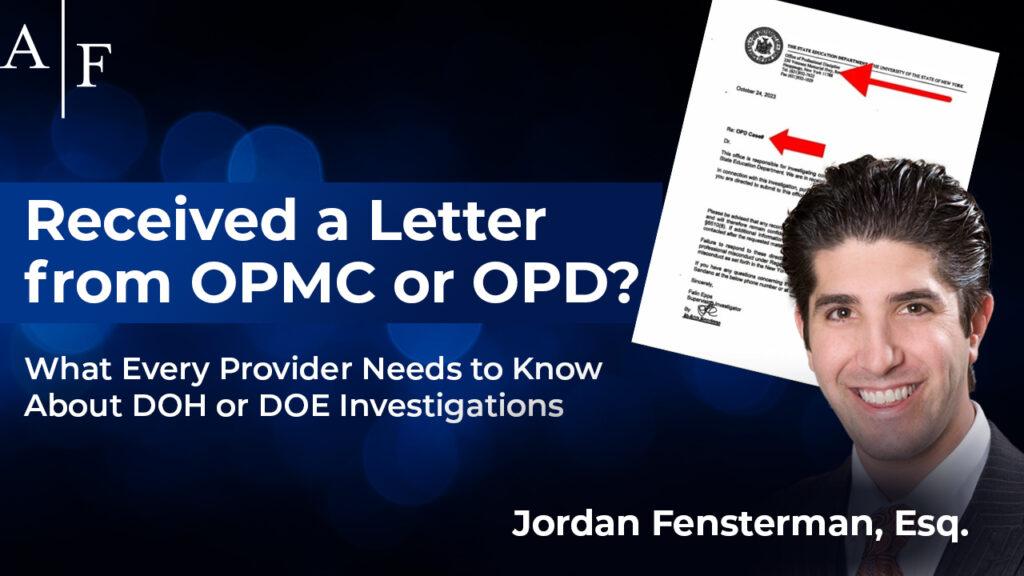


Learn How to Navigate OPMC & OPD Investigations
Published January 27, 2026. Revised May 29, 2026
By Jordan Fensterman, Esq, Executive Partner at Abrams Fensterman LLP, focusing his practice on OPMC and OPD investigations for New York licensed professionals.
Summary
New York healthcare and licensed professionals who receive a notice from the Office of Professional Medical Conduct (OPMC) or the Office of Professional Discipline (OPD) face serious risks to their licenses, reputations, and careers. This guide explains how complaints are handled, what investigators may request, key deadlines, common outcomes, and the practical steps you should take immediately after receiving notice to protect your professional standing.
Key takeaways:
- Do not ignore or casually respond to an OPMC or OPD letter.
- Contact experienced OPMC/OPD defense counsel before speaking with investigators or producing records.
- Preserve all relevant records and follow a structured response plan from day one.
What Are OPMC and OPD?
The Office of Professional Medical Conduct (OPMC) is a division of the New York State Department of Health that investigates complaints of professional misconduct involving physicians, physician assistants, and specialist assistants.
The Office of Professional Discipline (OPD) is part of the New York State Education Department and oversees investigations involving more than 50 licensed professions, including nurses, pharmacists, dentists, podiatrists, chiropractors, and many allied health providers.
Both agencies are required to review every complaint they receive — including anonymous or seemingly minor allegations — and determine whether further investigation is warranted.
Where appropriate, this page may link to official NYSDOH and NYSED resources so you can review the underlying regulations and procedures in more detail.
What To Do Immediately After Receiving an OPMC or OPD Notice
The first hours and days after receiving a letter, phone call, or email from OPMC or OPD can shape the entire course of your case. The following steps provide a practical roadmap.
Step 1: Do Not Respond Substantively Before Speaking With Counsel
- Do not call the investigator back to “explain” or “clear things up” before you have legal advice.
- Do not send records, emails, or written statements on your own.
- Remember that anything you say or provide can be used as evidence in the investigation.
Step 2: Consult Experienced OPMC/OPD Counsel Immediately
Hiring an attorney who regularly handles OPMC and OPD matters is critical. An experienced lawyer can:
- Explain the investigation process and typical timelines in plain language.
- Review the letter and any attached documents to identify the specific issues and potential exposure.
- Communicate directly with investigators on your behalf and help you avoid missteps that may harm your defense.
Step 3: Read and Organize the Notice and Attachments
Work with your attorney to carefully review:
- Deadlines for written responses, document production, or interviews.
- The type of complaint or allegation (clinical care, documentation, prescribing, boundary issues, billing, etc.).
- Any referenced statutes, regulations, or prior correspondence.
Create a central folder (physical or electronic) where you store all investigation‑related documents so nothing is lost or overlooked.
Step 4: Preserve Records and Evidence
From the outset, you should:
- Preserve and, where permitted, collect all relevant medical records, chart notes, billing records, emails, texts, and internal communications related to the complaint.
- Avoid altering or back‑dating any records; doing so can create additional misconduct issues.
- Identify potential witnesses (colleagues, staff, billing personnel) who may have relevant information and share these names with your attorney.
Step 5: Understand Your Rights
You are entitled to legal counsel during interviews and throughout the investigation, and you should exercise that right. In most situations, you are not required to speak informally with investigators without counsel present.
Your attorney can advise you on:
- Whether and how to participate in interviews or written statements.
- When to assert your rights against self‑incrimination or self‑incriminating disclosures.
- How the investigation may affect your license, hospital privileges, employment, and credentialing.
Step 6: Continue Practicing Professionally and Ethically
While the investigation is pending, maintain the highest professional and ethical standards in your practice. Cooperate with investigators in a strategic, lawful way, guided by your attorney, rather than out of fear or impulse.
How OPMC and OPD Investigations Work
Although every case is unique, most OPMC and OPD investigations follow a similar structure.
1. Complaint Intake
- A complaint may come from a patient, family member, colleague, employer, facility, insurance company, an anonymous source, news reports, online posts, or elsewhere.
- The agency reviews the complaint to determine whether it falls within its jurisdiction and whether it alleges potential professional misconduct.
- If the complaint is clearly outside their authority or lacks a basis for further review, it may be closed at this stage without contacting you.
2. Initial Review and Evidence Gathering
If the complaint proceeds beyond intake, investigators may:
- Request medical or business records from you or from third parties (such as hospitals or insurers). Always have an attorney involved before providing information to license investigative agencies!
- Review prior complaints or actions related to your license, if any.
- Investigators may look to interview complainants, witnesses, and sometimes other professionals who can speak to your practice.
Your attorney can help you respond to record requests in a way that is complete, compliant with privacy laws, and consistent with your defense strategy.
3. Regulatory Interviews
Investigators may ask you to attend an interview or provide a written statement. These meetings can be high‑risk without preparation because:
- Off‑hand or unguarded comments can be misunderstood or taken out of context.
- Incomplete explanations may be treated as admissions or inconsistencies.
- Statements you may believe exonerate you may actually hurt you in the long run.
An attorney experienced with OPMC and OPD matters will:
- Prepare you thoroughly for the interview, including practicing anticipated questions and answers.
- Attend the interview with you.
- Step in if questioning becomes improper or confusing.
4. Strategy Development
Once you and your attorney understand the facts and the agency’s concerns, you can work together to design a tailored defense strategy. This may include:
- Correcting inaccurate or misleading allegations.
- Gathering supporting documents (policies, protocols, training records) that show compliance.
- Obtaining witness statements from colleagues, staff, or other professionals.
- Identifying clinical or technical experts who can support your care or conduct when appropriate.
5. Settlement Discussions and Resolution Efforts
In many cases, if a matter proceeds past the investigation stage, it is possible to resolve a proceeding without a full disciplinary hearing. Depending on the facts and your goals, your attorney may:
- Communicate with the assigned counsel or investigator about the strength of the evidence and mitigating factors.
- Explore informal resolution options, such as educational or remedial measures.
- Negotiate settlement agreements, consent orders, or other resolutions that minimize collateral consequences, restrictions and long‑term consequences.
Possible Outcomes of OPMC and OPD Investigations
An investigation can lead to a range of results, including:
- Dismissal with no further action.
- Confidential or informal guidance, warnings, or remedial recommendations (such as additional education or charting improvements).
- Formal disciplinary charges that may proceed to an administrative hearing.
- Negotiated settlement agreements, consent orders, or stipulations.
- Administrative hearings before a designated body, which can result in findings and sanctions.
Potential sanctions may include:
- Fines or monetary penalties.
- Censure or reprimand.
- Practice limitations or conditions (monitoring, supervision, or restrictions on certain procedures).
- Suspension or revocation of a professional license in serious cases.
- In the most severe cases, revocation of license.
Your attorney can also discuss how any outcome may affect hospital privileges, insurance participation, credentialing, and reporting to national databases.
Common Missteps and Risks to Avoid
Attempting to manage an OPMC or OPD investigation without counsel is one of the most common — and preventable — mistakes. Missteps can include:
- Misinterpreting regulatory letters, subpoenas, or record requests.
- Missing procedural deadlines for responses, appeals, or hearings.
- Making unintended admissions during interviews or informal conversations.
- Providing incomplete, inconsistent, or disorganized records.
- Underestimating how statements made early in the process can affect final outcomes.
Early, proactive legal guidance helps you avoid these pitfalls, organize your response, and position your case for the best possible resolution.
Frequently Asked Questions FAQs
Who can file a complaint with OPMC or OPD?
Anyone can file a complaint, including patients, family members, colleagues, employers, insurance companies, facilities, and even anonymous sources. All complaints will be reviewed.
Will every complaint lead to discipline?
No. Many complaints are closed without action when they lack merit, fall outside the agency’s jurisdiction, or do not rise to the level of professional misconduct. Others may result in informal guidance rather than formal discipline.
Do I have to attend an investigation interview?
You may be asked or strongly encouraged to attend an interview or provide a statement, but you should never do so without first consulting an attorney. In many cases, you have the right to have counsel present and to prepare in advance.
Can I settle before formal charges are filed?
In some cases, yes. It is often possible to resolve concerns or negotiate a settlement before formal disciplinary charges are issued. Early involvement of experienced counsel gives you more options to address the agency’s concerns, correct misunderstandings, and work toward a resolution that protects your license and reputation.
About the Author
Jordan Fensterman, Esq., is an Executive Partner at Abrams Fensterman, LLP and leads the firm’s professional license defense practice. He has represented hundreds of New York licensed professionals in OPMC and OPD investigations, settlement negotiations, and administrative hearings. Mr. Fensterman has extensive experience representing physicians, physician assistants, dentists, nurses, pharmacists, and other licensed professionals in OPMC and OPD investigations and hearings throughout New York State. For more information about the firm’s OPMC and OPD work, you can review our dedicated OPMC/OPD practice pages and FAQs on our main website.
Contact Our OPMC & OPD Defense Team
If you have received a notice from OPMC or OPD, you should act promptly. Early legal engagement helps protect your license, reputation, and career, and can significantly influence the outcome of your case.
Our OPMC & OPD defense attorneys represent licensed professionals across New York State and can guide you through every phase of the process, from initial response to hearing and appeal.
Call Abrams Fensterman, LLP at (516) 368-9430 or visit our website to schedule a confidential consultation.