
New York Medicaid Fraud Control Unit Remains Suspended as Enforcement Activity Surges
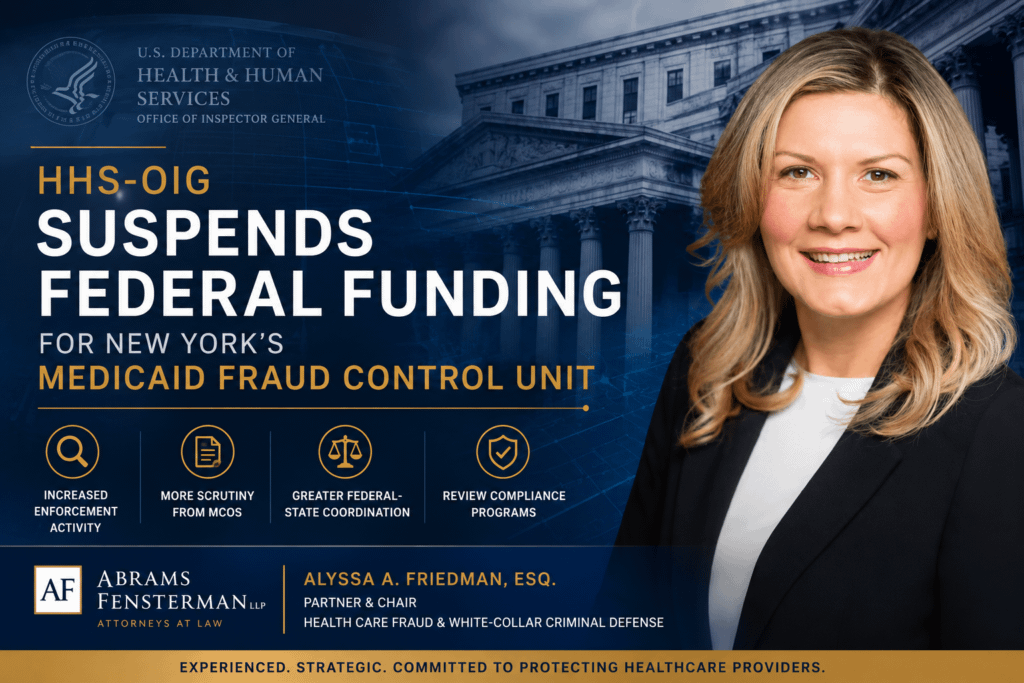
New York’s Medicaid Fraud Control Unit remains federally suspended and uncertified—but its enforcement activity is surging. Healthcare providers should not mistake the funding suspension for a slowdown in investigations or prosecutions.

Health Care Fraud & White-Collar Criminal Defense Practice
Abrams Fensterman LLP
This alert updates our June 30, 2026 client alert concerning HHS-OIG’s denial of recertification and suspension of federal funding for the New York Medicaid Fraud Control Unit. In its October 1, 2026 letter, HHS-OIG acknowledged meaningful corrective progress but determined that the Unit has not yet demonstrated that those improvements are lasting and sustainable.
In an October 1, 2026 letter, the U.S. Department of Health and Human Services Office of Inspector General (“HHS-OIG”) concluded that the New York Medicaid Fraud Control Unit (“MFCU”) has made meaningful progress toward correcting the deficiencies that led OIG to deny its recertification. OIG nevertheless determined that approximately three months of improvement was not enough to establish that those changes are lasting and sustainable.
MFCU therefore remains uncertified, its federal grant remains suspended, and it cannot presently draw FY 2027 grant funds. OIG will continue assessing the Unit’s performance monthly through December 31, 2026 before making a final determination on its request for reconsideration.
For healthcare providers, the more immediate concern is what MFCU is doing in response to that federal pressure.
Enforcement Activity Is Increasing
OIG’s latest letter reflects a sharp increase in MFCU enforcement. In FY 2026, MFCU obtained 50 fraud indictments, including 30 since July 1, compared with only seven fraud indictments in FY 2025. Criminal recoveries also increased substantially, from $1.7 million in FY 2025 to $19.8 million in FY 2026.
OIG has made clear that MFCU must demonstrate measurable results in fraud enforcement and patient abuse and neglect cases to regain certification. The practical consequence is continued pressure on the Unit to investigate, prosecute, and resolve more matters.
Managed Care Referrals Are a Particular Area of Focus
OIG continues to scrutinize the number and quality of fraud referrals coming from New York Medicaid managed care organizations.
Since July, MFCU has established monthly meetings with MCOs, created a dedicated MCO coordinator position, improved its referral tracking, and begun developing additional training concerning fraud referrals. More than 90 participants representing over 20 MCOs attended the first meeting.
For providers, this is significant. Managed care plans are themselves under pressure to identify and refer potentially fraudulent conduct to MFCU. Audits, repayment demands, or payment disputes involving billing, coding, documentation, medical necessity, credentialing, or ownership issues may therefore carry a greater risk of referral to law enforcement.
Older Cases Are Moving and Federal Coordination Is Increasing
OIG also criticized MFCU’s case progression. Since then, MFCU has reviewed older investigations and modified its case-management procedures. The percentage of open cases pending for more than three years has fallen from 34 percent to 24 percent.
Providers with longstanding MFCU matters should not assume that an older investigation will remain dormant.
At the same time, MFCU is increasing its coordination with federal authorities. The Unit reports 17 active joint criminal investigations with federal partners and has expanded its participation in healthcare fraud task forces.
That coordination increases the possibility that a Medicaid inquiry may develop into parallel state and federal scrutiny involving MFCU, HHS-OIG, federal prosecutors, CMS contractors, OMIG, managed care plans, or other enforcement entities.
What Healthcare Providers Should Be Doing Now
The October 1 letter should dispel any assumption that MFCU’s funding suspension has weakened Medicaid enforcement in New York. The opposite appears to be occurring: MFCU is under substantial federal pressure to produce more cases, move investigations more quickly, generate stronger referrals, and demonstrate tangible enforcement results.
Healthcare providers should use this period to assess potential areas of exposure before an audit, subpoena, repayment demand, or investigative request arrives.
- Medicaid billing, coding, and supporting documentation;
- medical necessity and service-delivery records;
- managed care audits, repayment demands, and SIU activity;
- credentialing, enrollment, and ownership disclosures;
- internal compliance investigations and identified overpayments;
- quality-of-care and patient abuse or neglect issues; and
- existing MFCU, OMIG, OIG, CMS, or managed care matters that have remained unresolved.
Providers already under review should also consider whether the current enforcement environment changes the strategy surrounding an existing matter. An issue that begins as a routine audit or payment dispute may now present a greater risk of referral, escalation, or parallel investigation.
Looking Ahead
OIG will continue reviewing MFCU through the end of 2026 and may ultimately restore its certification and federal funding if the Unit demonstrates sustained progress.
For providers, however, the relevant development is happening now. New York Medicaid enforcement is intensifying while MFCU is under direct pressure to demonstrate results. Providers facing audits, repayment demands, subpoenas, or investigations should evaluate those matters early, before an administrative issue develops into a broader civil or criminal enforcement matter.
Abrams Fensterman will continue monitoring the MFCU recertification process and its implications for healthcare providers facing government and managed care investigations.
Health Care Fraud & Regulatory Defense Practice
Abrams Fensterman’s Health Care Fraud & Regulatory Defense Practice represents healthcare providers in civil, criminal, and administrative investigations involving Medicaid fraud, Medicare and Medicaid audits, managed care audits, patient abuse and neglect allegations, False Claims Act matters, and related enforcement proceedings.
Alyssa A. Friedman, Esq. Partner & Chair
(718) 215-5300 | [email protected]
Learn More About Our Healthcare Fraud & Regulatory Defense Practice →