

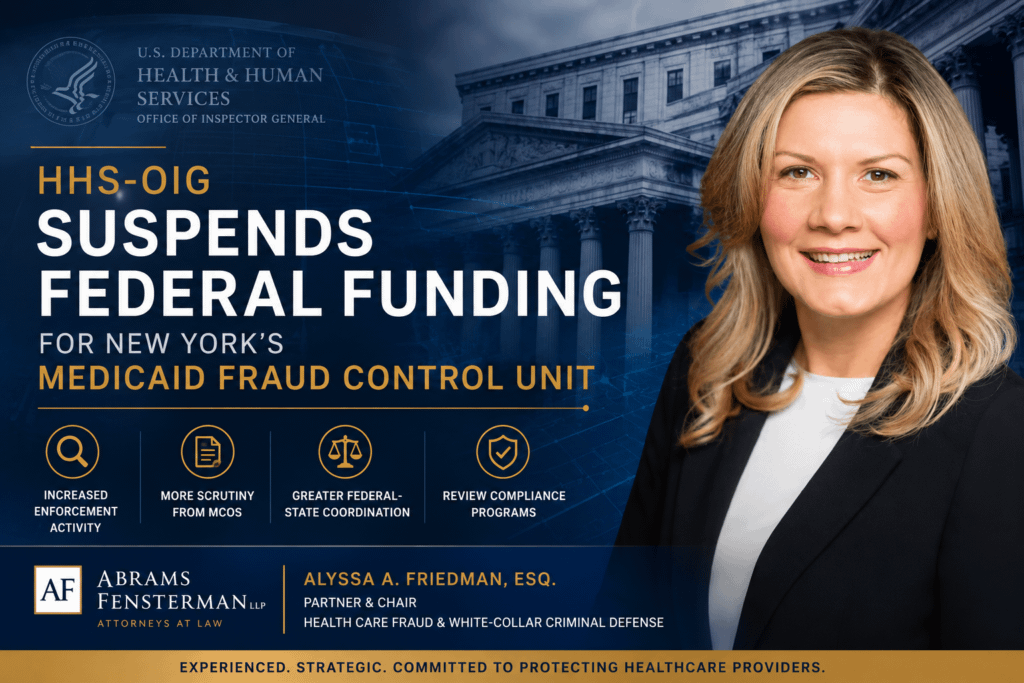
HHS-OIG Suspends Federal Funding for New York Medicaid Fraud Control Unit

Health Care Fraud & White-Collar Criminal Defense Practice
Abrams Fensterman LLP
October 2026 Update: New York’s Medicaid Fraud Control Unit remains federally suspended and uncertified, while enforcement activity has increased. Read our updated client alert, New York Medicaid Fraud Control Unit Remains Suspended as Enforcement Activity Surges, for the latest developments and implications for healthcare providers.
HHS-OIG Suspends NY MFCU Funding
On June 30, 2026, HHS-OIG issued a letter denying annual recertification of the New York State Medicaid Fraud Control Unit (“NY MFCU”) and suspending its federal grant funding effective July 1, 2026. The suspension is stated to run through September 30, 2026, unless the NY MFCU demonstrates sufficient corrective action before that date.
The NY MFCU, which operates within the New York State Office of the Attorney General, investigates Medicaid fraud and patient abuse & neglect. According to HHS-OIG, New York receives approximately $60 million annually in federal funding for the Unit and employs more than 270 staff.
HHS-OIG concluded that, despite those resources, the Unit is not effectively carrying out its statutory responsibilities under the Social Security Act and 42 C.F.R. Part 1007.
HHS-OIG’s principal criticism is that the NY MFCU has underperformed in criminal Medicaid fraud prosecutions and patient abuse and neglect prosecutions when compared with similar-sized MFCUs in other states.
The letter asserts that New York has focused too heavily on “high-impact, complex fraud cases,” which HHS-OIG characterizes as a shift toward civil fraud matters at the expense of criminal enforcement.The letter highlights several specific concerns. HHS-OIG states that New York ranked last among comparable large-state MFCUs for criminal fraud convictions and indictments, reporting 53 fraud convictions from 2023 through 2025 while the next-lowest comparable state had 129. It also criticizes the Unit’s patient abuse and neglect results, stating that New York obtained only four such convictions from 2023 through 2025 despite receiving more than 2,000 patient abuse and neglect allegations annually.
Operational Concerns Identified
HHS-OIG also identifies operational concerns, including the Unit’s staffing mix, low-quality or insufficient referrals from Medicaid managed care organizations, and case-progression delays.
The letter states that 34% of open cases are more than three years old and that 69% of referrals from the State Medicaid Program Integrity Unit had been pending at the NY MFCU for two years or more. HHS-OIG further states that the Unit must improve cooperation with HHS-OIG’s Office of Investigations, particularly on joint Medicare/Medicaid cases, deconfliction, and tracking referred prosecutions.
Corrective Action Timeline
To regain recertification, the NY MFCU must submit corrective-action plans within 30 days and progress reports within 90 days. HHS-OIG directed the Unit to address staffing, referral generation, case progression, and cooperation with federal investigators.
If HHS-OIG determines that the Unit has sufficiently remediated the identified issues before September 30, 2026, the suspension may be lifted. Otherwise, the Unit’s recertification will remain denied, and HHS-OIG states that federal grant funding will not be awarded for FY 2027.
What This Means for Providers
For New York Medicaid providers, the suspension is an important enforcement signal that may affect future investigations, audits, compliance expectations, and government enforcement priorities.
Increased Enforcement Activity
Most significantly, HHS-OIG is criticizing the NY MFCU for not bringing enough criminal Medicaid fraud and patient abuse and neglect cases. That criticism will create pressure on the Unit to increase criminal referrals, accelerate pending investigations, pursue older matters more aggressively, and work more closely with federal agencies. If funding is restored, the Unit will ramp up activity on older cases and begin investigating new ones. There will also be staffing changes and additional hiring that will make the Unit more active.
Increased Referrals from MCOs to the MFCU
Providers that participate in New York Medicaid managed care should expect the MCOs to increase scrutiny of billing, medical necessity, documentation, credentialing, ownership disclosures and referral patterns. Nursing homes, home care agencies, behavioral health providers, transportation providers, pharmacies, therapy providers, and other high-volume Medicaid providers will see heightened attention in areas involving both reimbursement and quality-of-care allegations.
Civil Cases May Receive Criminal Scrutiny
Civil audit disputes, repayment demands, and administrative investigations may receive more aggressive review where the government believes the facts could support criminal fraud, false statement, kickback, neglect, or patient-endangerment theories.
Greater Federal-State Coordination
HHS-OIG specifically directed NY MFCU to cooperate more fully with HHS-OIG and federal enforcement authorities. This will mean more joint federal-state activity, greater information sharing, and more frequent coordination among the NY MFCU, HHS-OIG, CMS, OMIG, managed care plans, and other law enforcement partners. Cases that were handled by the state may now “go federal.”
Review Compliance Programs & Internal Controls
Providers should review their Medicaid compliance programs, internal reporting processes, documentation practices, managed care billing controls, and procedures for responding to subpoenas, audit demands, records requests, and investigator contact. Providers with pending MFCU, OMIG, OIG, CMS, managed care, or law enforcement matters should evaluate whether this development may affect case strategy, timing, settlement posture, or criminal exposure analysis.
Looking Ahead
Abrams Fensterman remains committed to supporting our clients as this situation evolves and will continue to monitor developments closely, provide timely updates, and advise healthcare providers on the potential operational, regulatory, and enforcement implications arising from these developments.
Experienced Counsel for Healthcare Providers Facing Government Scrutiny
Abrams Fensterman’s Health Care Fraud & Regulatory Defense Practice represents healthcare providers in civil, criminal, and administrative investigations involving Medicaid fraud, Medicare and Medicaid audits, managed care audits, patient abuse and neglect allegations, False Claims Act matters, and related enforcement proceedings.
Related Topics
Contact Us
Local Respect,
State-Wide Reach
For further information about our experience, please contact our law firm on Long Island at 516-328-2300, in Brooklyn at 718-215-5300, White Plains at 914-607-7010, Rochester at 585-218-9999 or Albany at 518-535-9477 to schedule an initial consultation.