
 |
Published November 21, 2026 Author: Jordan Fensterman, Esq. Executive Partner and Director of of the OPMC & OPD Defense Practice at Abrams Fensterman, LLP. 516-368-9430 |
Gastroenterology – OPMC Colon Perforation Defense
OPMC and Colon or Intestinal Perforation Cases: What New York Gastroenterologists Should Know
Is a Colon or Intestinal Perforation During Colonoscopy a Sign of Medical Misconduct?
A colon or intestinal perforation during colonoscopy or upper endoscopy is a recognized, common complication, not automatic evidence of wrongdoing. New York’s Office of Professional Medical Conduct examines whether the physician recognized the perforation, documented it, and responded appropriately, meeting accepted standards. Abrams Fensterman’s OPMC defense attorneys help New York gastroenterologists respond to complaints and investigations involving any perforation.
Colon and Intestinal Perforation Is a Known Risk of Gastroenterology Procedures
It is one of the most serious complications associated with colonoscopy and upper endoscopy, and it is a recognized risk of these procedures rather than an unusual event that occurs only through error. A large, pooled analysis reviewed by the American Society for Gastrointestinal Endoscopy found a perforation rate of approximately 5.8 per 10,000 colonoscopies. ASGE’s own quality benchmarks set an expected perforation rate of less than 1 in 500 for all colonoscopies and less than 1 in 1,000 for screening colonoscopies, meaning some perforations are expected to occur even when a gastroenterologist follows accepted technique.
This distinction matters for New York physicians because it separates two very different questions. The first is a clinical question: did a perforation occur? The second is a regulatory question: did the physician’s conduct before, during, or after the procedure fall below the standard that New York law requires of a licensed practitioner? A perforation alone does not answer the second question.
When Does a Colon or Intestinal Perforation Become an OPMC Matter?
The New York State Office of Professional Medical Conduct (OPMC) is required by law to investigate every complaint it receives, whether it comes from a patient, a family member, a hospital, or another provider. A complication such as a perforation can prompt a complaint on its own, or OPMC involvement can follow a related malpractice claim, a hospital incident report, or a mandatory reporting obligation.
OPMC does not treat every perforation as misconduct. Under New York Education Law Section 6530, professional misconduct includes practicing with negligence on more than one occasion, practicing with gross negligence on a particular occasion, practicing with incompetence on more than one occasion, and practicing with gross incompetence. A single perforation, standing alone, is not automatically gross negligence or gross incompetence. What OPMC examines is whether the specific facts of that procedure and its aftermath meet one of these definitions, which is a different and higher bar than simply asking whether an injury occurred.
What OPMC Reviews in a Colon or Intestinal Perforation Complaint
An OPMC review of a gastroenterology perforation case can focus on the physician’s conduct at several points, not on the perforation itself:
- Recognition and response. Whether signs of a possible perforation, such as new or worsening abdominal pain, distension, fever, or abnormal vital signs, were identified and acted on promptly after the procedure.
- Documentation. Whether the medical record accurately reflects the evaluation, the procedure, and the treatment provided. New York Education Law Section 6530 separately defines a failure to maintain an accurate patient record as its own basis for professional misconduct.
- Informed consent disclosures. For non-emergency procedures involving anesthesia, New York law requires that the patient be told which physicians are reasonably expected to be involved and that their participation be consented to. Gaps in this disclosure process can become a separate issue in an OPMC review.
- Escalation and follow-up care. Whether the physician arranged appropriate imaging, surgical consultation, or transfer of care once a perforation was suspected or confirmed.
None of these factors turn on whether a perforation happened. They turn on what the physician did and documented, which is why two physicians who each experience a perforation can face very different outcomes depending on their conduct and records.
OPMC Discipline Is Separate from a Malpractice Lawsuit
A colon or intestinal perforation can lead to two different, independent proceedings. A patient may bring a civil medical malpractice lawsuit seeking compensation for the injury. Separately, OPMC may open its own licensing investigation, which can result in penalties up to and including suspension or revocation of a medical license, regardless of how any civil case is resolved. A physician can face an OPMC investigation even if no malpractice suit is ever filed, and the reverse is also true.
Because these two proceedings ask different questions and carry different consequences, statements, records, and strategic decisions made in one can affect the other. Abrams Fensterman’s Medical Malpractice Defense division and OPMC defense team coordinate on cases that involve both tracks.
What to Do If OPMC Contacts You After a Perforation Event
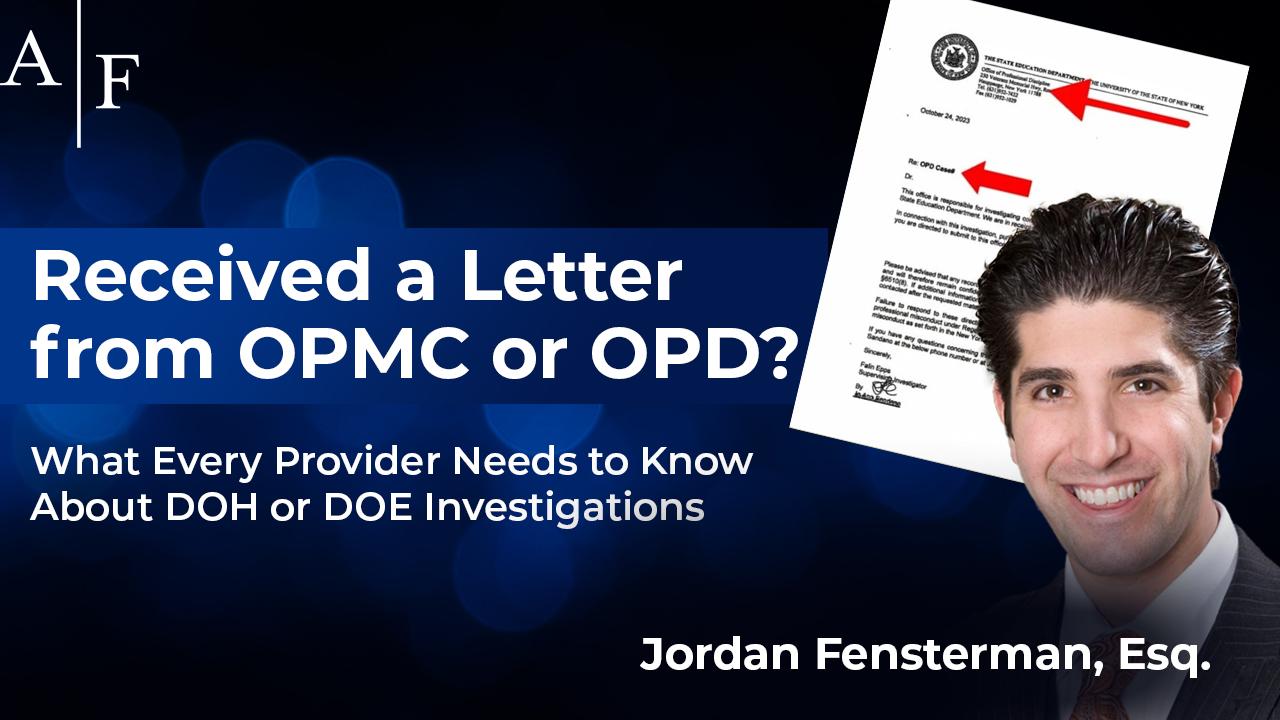
A gastroenterologist who receives a letter, a records request, or a call from OPMC following a perforation complication should treat it as the start of a professional license investigation, not a routine inquiry. Abrams Fensterman’s general guide, What to Do When the OPMC Calls, covers the practical first steps that apply regardless of specialty. Early legal representation can help a physician avoid statements or documentation choices that later hurt the defense and can help ensure that any response accurately reflects the clinical realities of colonoscopy and endoscopy complications, including recognized perforation rates and accepted management standards.
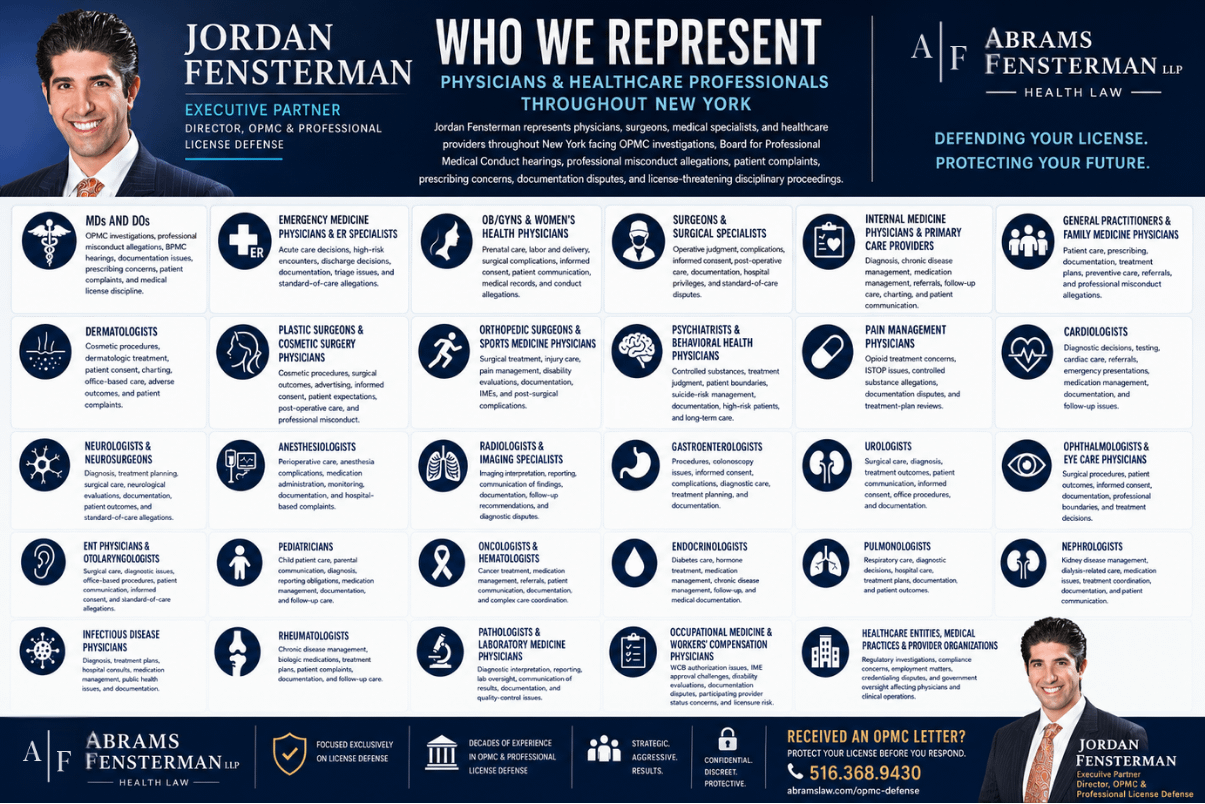
For a full explanation of how an OPMC complaint moves from initial contact through investigation and, if necessary, a hearing, see Abrams Fensterman’s OPMC Defense overview. Jordan Fensterman and the OPMC defense team at Abrams Fensterman, LLP represent physicians across specialties, including gastroenterology, in OPMC investigations and hearings throughout New York.
A gastroenterologist facing an OPMC investigation may also face a medical malpractice claim arising from the same incident. Abrams Fensterman’s Medical Malpractice Defense division and OPMC defense attorneys work together as one coordinated defense team when both proceedings are in play, because what is said or produced in one proceeding can matter in the other. You can review representative outcomes in our summary of proven OPMC defense results, and general questions about the process are answered in our OPMC and OPD license defense FAQs.
Frequently Asked Questions
Does a colon perforation automatically mean a gastroenterologist did something wrong?
No. Perforation is a recognized complication of colonoscopy and upper endoscopy that can occur even when accepted technique is followed. Whether it also constitutes professional misconduct depends on the physician’s specific conduct and documentation, not on the fact that a perforation occurred.
Can OPMC discipline a physician for a single perforation incident?
It is possible. New York Education Law Section 6530 defines gross negligence on a single occasion and gross incompetence as independent grounds for professional misconduct, separate from the provisions that require more than one occasion. Whether a single incident meets that standard depends on the specific facts.
Protect Your Medical License and Your Career
If you are a gastroenterologist facing an OPMC investigation involving a colonoscopy complication, intestinal perforation, or allegations of professional misconduct, Abrams Fensterman can help you navigate the investigation and protect your professional interests.
Contact
Jordan Fensterman,
Executive Partner and Director of OPMC & OPD Defense.
Representing physicians and medical professionals throughout New York.