

 |
Published June 14, 2026 Author: Jordan Fensterman, Esq. Executive Partner and Director of of the OPMC & OPD Defense Practice at Abrams Fensterman, LLP. 516-368-9430 |
Will a DWI Conviction Affect a Physician’s Medical License in New York?
What Happens to a New York Physician’s License After a DWI Conviction?
A DWI conviction for a New York physician creates two separate legal exposures: the criminal case itself and a possible inquiry from the Office of Professional Medical Conduct. At Abrams Fensterman, criminal defense and OPMC defense are coordinated together, since decisions made in the criminal case can directly affect the licensing outcome.
Why a DWI Conviction Is Not Just a Criminal Matter for Physicians
A DWI conviction sits at the intersection of two systems that move on different clocks. The criminal case proceeds through arraignment, plea negotiations, and possibly trial. Separately, New York physicians face reporting obligations tied to convictions, both through license renewal disclosures and through many hospitals’ own credentialing bylaws.
Under New York law, conviction of a “crime,” as distinct from a lesser violation or infraction, is what triggers professional-misconduct exposure at the licensing level, so the specific charge and its ultimate disposition matter enormously. Hospitals, for their part, must report certain physician judgments of conviction to the state within a set window, which means the physician’s own institution can trigger scrutiny independent of anything OPMC does on its own.
In the first 48 hours after a conviction the priorities are securing criminal counsel, reviewing any hospital bylaw or license renewal disclosure deadline, and avoiding statements to investigators, employers, or colleagues before counsel has weighed in. The criminal case and any OPMC inquiry run on separate but related timelines, and a decision made early in the criminal matter, such as accepting a plea, can be used later in a licensing proceeding.
How Abrams Fensterman Coordinates Criminal Defense and OPMC Defense
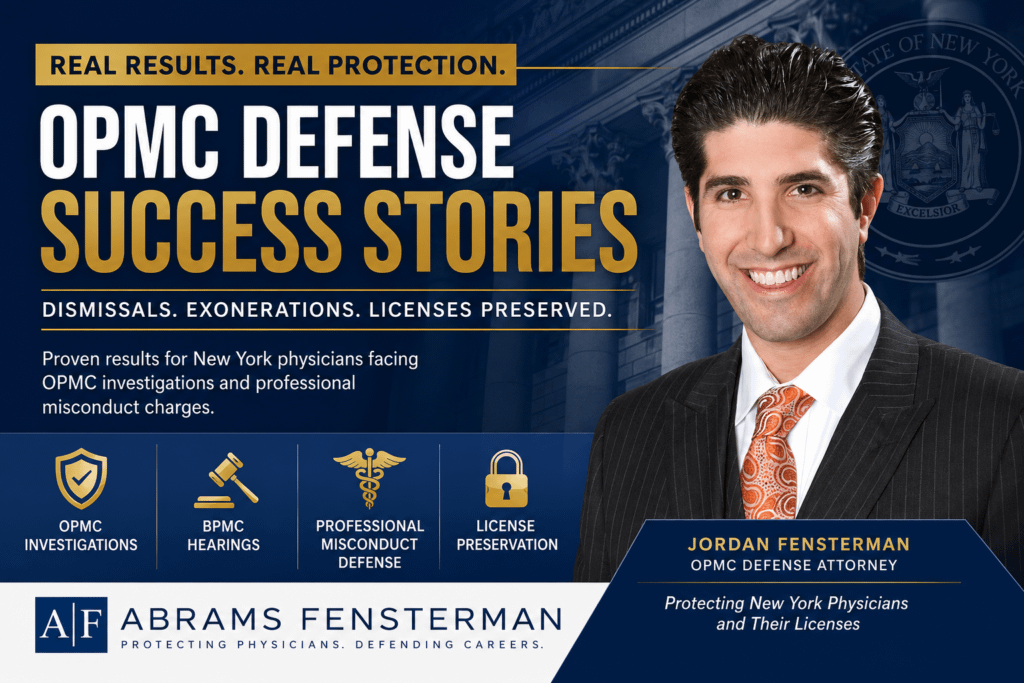
Jordan Fensterman, Executive Partner and Director of the OPMC & OPD Defense Practice at Abrams Fensterman, LLP, leads the firm’s physician licensing defense and has represented physicians through OPMC inquiries, investigations, and hearings.
On the criminal side, the firm’s coordinated criminal defense team, which includes former prosecutors, works alongside the OPMC team so that decisions in the criminal case are made with the licensing exposure in view from day one, rather than as an afterthought once a plea has already been entered.
What Happens After a Physician’s DWI Conviction? Step by Step
Conviction and arraignment on the underlying DWI or DWAI charge.
Reporting obligations come due, license renewal disclosure and, where applicable, hospital bylaw self-reporting.
A possible OPMC inquiry letter requesting records or an interview.
Hospital credentialing committee review, for physicians with hospital privileges.
Resolution of the criminal case through plea, trial, or dismissal.
OPMC outcome: dismissal, a consent agreement, or referral to a disciplinary hearing.
Frequently Asked Questions About DWI Convictions and OPMC
Does a DWI conviction trigger an OPMC investigation for a New York physician?
Not automatically, but it can. New York’s Office of Professional Medical Conduct (OPMC) may open a review when it learns of a physician’s conviction, particularly for offenses involving impairment, judgment, or public safety. Whether an investigation follows depends on the charge, any conviction, and whether the physician self-reports as required.
Does a physician have to report a DWI conviction to OPMC or their hospital?
New York physicians generally have reporting obligations tied to criminal charges and license renewal disclosures, and many hospitals and health systems have their own credentialing bylaws requiring self-reporting of criminal convictions. Missing a reporting deadline can create separate exposure beyond the underlying DWI conviction, so this should be assessed immediately.
Should a physician convicted of DWI in New York hire a criminal defense lawyer or an OPMC lawyer?
Both concerns should be handled together from the start. A criminal DWI charge and OPMC licensing exposure run on separate tracks with separate deadlines, and decisions made early in the criminal case can materially affect the OPMC side. Physicians are best served by counsel who coordinate both sides from day one.
What is the difference between a DWI and a DWAI in New York?
New York primarily uses “DWI” (Driving While Intoxicated) for alcohol-related offenses at or above the legal BAC threshold, and “DWAI” (Driving While Ability Impaired) for lesser impairment. The distinction matters for licensing purposes because only conviction of a “crime,” not a lesser violation, triggers professional-misconduct exposure on its own.
Can a DWI conviction cost a physician their medical license in New York?
It can, though outcomes vary based on the specifics: whether it is a first offense, whether anyone was injured, whether controlled substances were involved, and how the physician responds to any OPMC inquiry. A conviction does not automatically mean license revocation, but an unaddressed or mishandled case carries that risk.
Facing DWI-Related Licensing Consequences? Protect Your Medical License.
Jordan Fensterman represents physicians throughout New York facing OPMC investigations, professional misconduct allegations, disciplinary hearings, license-renewal disclosure issues, and other matters that may threaten their medical licenses and careers.
Call Today: (516) 368-9430